Regis III Stay-Within-View Rule
The InvincibleThe Regis III Stay-Within-View Rule is the Invincible expedition’s defining operational safeguard on Regis III. Its decisive principle is simple: an individual working outside a protective force field may move freely, but must remain within the sight of someone who is protected. The rule acknowledges that survival cannot be secured by withdrawal alone; exploration requires exposure, and exposure requires an accountable witness.
Origin and Purpose
The rule emerges from the inadequacy of both heavy protection and total remote control. The commander considers surrounding expeditionary teams with energobots and force fields, issuing each researcher an individual transmitter, and even keeping all personnel aboard the ship while robots perform the work remotely. Each solution creates a different failure: force-field bubbles restrict contact with the environment, overly narrow fields can burn the person inside them, and robot-only operations are useful for hours or perhaps a day but not for a prolonged investigation.
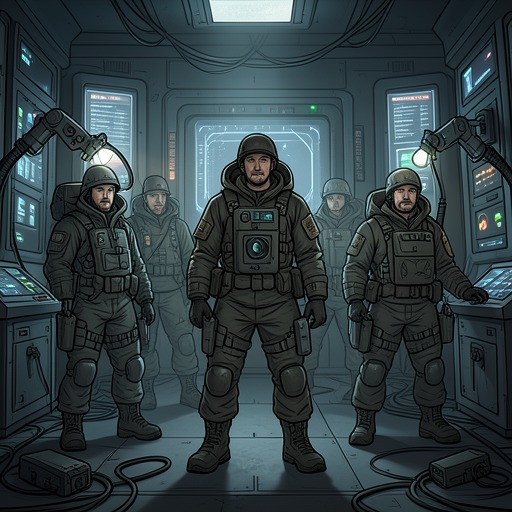
The adopted arrangement therefore divides protection between a collective base and a human observer. Each team is to establish a force-field-protected base camp, while researchers outside it retain full freedom of movement. The price of that freedom is reciprocal visibility: anyone beyond the field must be backed up by someone inside protection who can watch the person’s movements. On Regis III, remaining within view is identified as the expedition’s most important rule.
Application in the Field
The rule governs movement through environments whose danger cannot be reliably identified in advance. During the search for missing personnel, Rohan’s convoy approaches two broad gateways in the rock while technicians narrow the force field with great precision. The concern is not merely that the vehicles might strike the cracked pillars; a disturbance could trigger a rockfall and injure or kill missing men nearby. The procedure shows how visibility and protection operate together: the expedition must enter uncertain terrain, but it must do so while preserving the possibility of monitoring and rescue.
The same logic shapes the expedition’s broader spatial organization. The Invincible remains the secure center, force-field camps mark temporary protected zones, and ravines, ruins, desert, and other sites become controlled corridors of investigation rather than freely inhabitable space. Earlier orbital observation is recognized as insufficient because a complete photographic survey would take almost a month and telescopic viewing cannot substitute for direct investigation. The rule is thus a compromise between the limits of remote knowledge and the risks of bodily presence.
Rule Under Pressure
The protocol is especially significant because Regis III contains hazards that defeat ordinary assumptions about an enemy. The planet shows life in the ocean but no recent life on land, while ancient terrestrial organisms disappeared as metallic strata accumulated. Researchers also encounter metallic fragments, radioactive concentrations, rusted mechanism-like remains, and formations that may operate as swarms or as an inanimate brain. The danger is not necessarily a visible adversary with intentions; it may be a distributed system responding automatically to threat or environmental change.
In the ravine, the rule’s practical limits become apparent. Radio contact with the supercopter deteriorates among the metal bushes. Sensors register magnetic impulses from every direction, and the bushes prove structurally different from those previously encountered. Rohan refuses to investigate them by opening the force field, choosing caution because the expedition cannot yet determine what the formations are or how they respond. Above the black thicket, the air trembles and smoke-like wisps appear; Jarg interprets them as possible swarms of tiny insects. The rule does not eliminate danger, but it preserves a protected observer and makes unmonitored exposure unacceptable.
Knowledge, Command, and Consequence
The rule also organizes the expedition’s argument about what certainty means. Horpach resists returning with hypotheses alone and wants accurate diagnosis, established facts, and, if possible, samples of the flying mechanical fauna. Lauda argues that these formations may be products of inanimate evolution rather than thinking opponents, and that treating them as enemies would be as irrational as punishing the ocean for sinking a ship. The demand for certainty therefore conflicts with the safety system: investigation requires approaching the unknown, while the unknown may be precisely what makes observation impossible.
The protocol’s deepest consequence is ethical as well as tactical. Rohan eventually recognizes that the expedition’s confidence in cannons and sensors has encouraged rash decisions and that the losses are the result of human error, not a moral debt owed by Regis III. He comes to reject the idea that humanity has earned the right to impose itself everywhere, especially on a system that has maintained its own equilibrium over millions of years. In this light, staying within view is more than a field instruction. It is a modest restraint on human power: a reminder that movement must remain answerable to others, and that entering another world does not confer the right to destroy what cannot be understood.
Narrative Significance
The Regis III Stay-Within-View Rule turns visibility into a condition of survival, knowledge, and responsibility. It produces a carefully monitored form of exploration in which the protected and the exposed depend on one another, yet it cannot guarantee that the threat will be seen, named, or recognized as a threat at all. Rohan’s later vulnerability at the ravine makes the rule’s irony stark: the thing he fears has no eyes, while the human demand to see and supervise becomes powerless before an environment whose decisive processes are distributed, mechanical, and indifferent.
The rule consequently stands between two illusions: that technology can make exploration safe, and that every danger must possess an intention that humans can confront. It gives the expedition a workable discipline, but its larger value lies in the humility it imposes. On Regis III, to remain within view is to admit that no individual observer is sufficient, that protection depends on relation, and that the unknown must not automatically be converted into an enemy.